

Dorie Miller Hero of Pearl Harbor and Trailblazer in Navy History
On the morning of December 7, 1941, Doris “Dorie” Miller was not assigned to fire a weapon. Like many Black sailors in the U.S. Navy at the time, he worked in a service role, far from the combat duties that often led to medals and public praise.
Then the attack on Pearl Harbor began.
In the smoke, noise, and terror aboard the USS West Virginia, Miller did what courage often demands. He moved toward danger. He helped the wounded. He manned an anti-aircraft gun he had not been trained to use. His actions made him a national hero and the first African American recipient of the Navy Cross, one of the Navy’s highest awards for valor.

Early life in Waco shaped his strength and character.
Doris Miller was born on October 12, 1919, in Waco, Texas. He grew up in a working-class family during an era defined by racial segregation and limited opportunity for African Americans.
Known by his nickname “Dorie,” Miller was strong, athletic, and dependable. He attended A.J. Moore High School, where he played football and gained a reputation as a powerful presence. Those traits would later matter in a very different setting.
Life in Texas during Miller’s youth did not offer an easy path. Jobs were limited. The military, despite its own discrimination, offered steady pay, structure, and a chance to serve beyond the boundaries of home. In 1939, Miller enlisted in the U.S. Navy.
At the time, the Navy did not give Black sailors equal access to all specialties. Many were restricted to work as mess attendants, cooks, and stewards. Miller entered that system and served as a mess attendant, a role that included food service and support duties for officers and crew.
Miller’s Navy career began in a segregated service.
Before the United States entered World War II, Miller served aboard several ships and eventually joined the battleship USS West Virginia. By late 1941, the ship was stationed at Pearl Harbor in Hawaii, part of the Pacific Fleet.
Miller’s official duties were not glamorous. He worked in the ship’s mess and helped keep daily ship life running. He also became known for his physical strength and had success as a shipboard boxer.
That mix of discipline, endurance, and calm under pressure mattered on December 7.
The U.S. Navy of 1941 had strict racial limits. Black sailors often faced discrimination even while wearing the same uniform and serving the same country. Miller’s story is powerful partly because his heroism took place inside a system that had not expected, trained, or fully allowed him to fight.

Heroism during the attack on Pearl Harbor
The Japanese attack on Pearl Harbor began just before 8 a.m. on December 7, 1941. The USS West Virginia was hit by torpedoes and bombs. Fires spread. Sailors were killed and wounded. The ship began taking on water.
Miller was collecting laundry when the alarm sounded. He reported to his battle station, but damage had made that area unusable. He was then sent to help move the ship’s wounded commanding officer, Captain Mervyn Bennion, who had been gravely injured.
Miller helped carry wounded sailors to safer areas. Then, despite having no formal training on the weapon, he took control of a .50-caliber anti-aircraft machine gun and fired at attacking Japanese planes.
He later described the action in plain terms. He had watched others use the gun. When the moment came, he used what he had seen and kept firing until he ran out of ammunition or was ordered to leave.
That act became one of the most remembered moments of Pearl Harbor. Miller did not wait for permission to be brave. He acted when people around him needed help.
His courage also challenged racist assumptions that had shaped Navy policy. The nation saw a Black sailor, assigned to a limited service role, perform with extraordinary composure in one of the most devastating attacks in American history.
The Navy Cross honored a breakthrough moment.
At first, Miller’s identity was not widely publicized. Early reports described an unnamed Black messman who showed great bravery during the attack. Civil rights groups, Black newspapers, and community leaders pushed for full recognition.
Their efforts mattered.
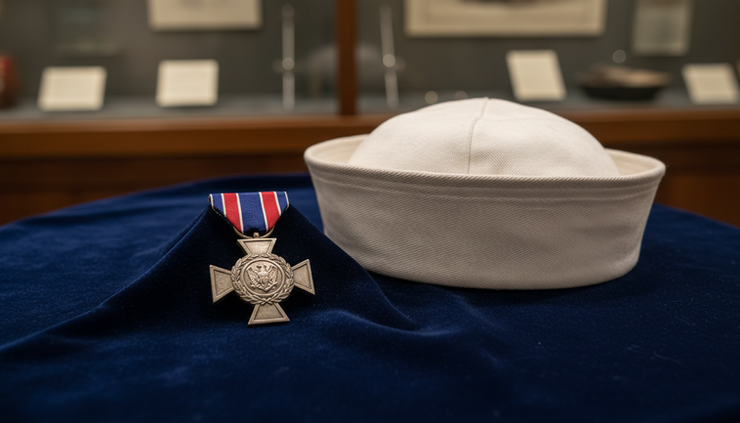
On May 27, 1942, Admiral Chester W. Nimitz presented Miller with the Navy Cross. The ceremony took place aboard the aircraft carrier USS Enterprise. The award made Miller the first African American to receive the Navy Cross.
Miller’s medal recognized more than one man’s bravery. It forced the country to see the courage of Black service members who had long served under unequal rules.
The award did not end discrimination in the military. It did not erase the barriers Black sailors still faced. But it created a public example that could not be ignored.
Miller became a symbol of service, patriotism, and dignity. He toured in support of war bond efforts and inspired many Americans, especially African Americans who saw in him proof of what Black service members had always been capable of doing.
His final service came aboard the USS Liscome Bay
After Pearl Harbor, Miller continued to serve. He was later assigned to the escort carrier USS Liscome Bay.
On November 24, 1943, during operations in the Pacific near the Gilbert Islands, the Liscome Bay was struck by a torpedo from a Japanese submarine. The ship sank after a massive explosion. Hundreds of sailors died.
Miller was listed as missing and later declared dead. He was 24 years old.
His death came before he could see the full impact of his own legacy. Yet that legacy continued to grow because his story carried moral weight. He had served a country that did not yet treat him equally. He had still acted with courage, loyalty, and skill when the stakes were life and death.
Dorie Miller’s legacy changed how Americans remember service
Dorie Miller, Hero of Pearl Harbor and Trailblazer in Navy History, is more than a fitting title. It captures why his life still matters.
Miller’s legacy reaches across military history, civil rights history, and American memory. His actions helped widen the public understanding of who could be seen as a hero. They also added pressure to the long push for equal opportunity in the armed forces.
The U.S. military would not fully desegregate until after World War II, when President Harry S. Truman issued Executive Order 9981 in 1948. Miller did not live to see that change, but his example helped make the old system harder to defend.
His name has lived on through memorials, schools, parks, and Navy ships. The destroyer escort USS Miller honored him in the 1970s. In 2020, the Navy announced that a future aircraft carrier would be named USS Doris Miller, a major recognition of his place in naval history.
That honor carries deep meaning. Aircraft carriers are among the Navy’s most visible symbols of national power. Placing Miller’s name on one recognizes the value of an enlisted sailor whose courage rose above the limits placed on him.

Why Dorie Miller’s story still inspires
Dorie Miller’s life reminds us that history often turns on the choices of people who were never expected to stand at the center of it.
He was not trained for the gun he fired at Pearl Harbor. He was not given equal access to combat roles. He was not treated as fully equal by the institution he served. Yet when the moment came, he protected his shipmates and fought back with everything he had.
His story continues to inspire because it combines bravery with perseverance. It honors the service of African Americans in World War II and points to the larger struggle for fairness inside American institutions.
Dorie Miller did not set out to become a symbol. He set out to serve. In doing so, he became a lasting example of courage under fire, and a reminder that true heroism is measured by action when action matters most.


Comments